Skip to content





Cutting-edge data platforms open new doors to businesses, as they enable enterprise AI and inform strategic decisions. However, successful transformation takes a holistic approach to the modern data platform adoption that goes far beyond the technology itself.
While many enterprises invest heavily in modern data platforms on the cloud, they often struggle to see tangible business impact and real user adoption. This gap exists because the platform is sometimes viewed as a technical tool rather than a cultural enabler.
In this article, I will share practical insights into how data leaders can plan and execute a transformation programme that places the needs and workflows of the people using the data at the centre of the design process to genuinely change the organisation’s operations.
Diversity of stakeholders
The most certain way to set a data transformation up for failure is treating all data users as a single, homogenous group.
In reality, stakeholders – from executive decision-makers and financial analysts to operational field teams and business unit managers – have vastly different objectives, priorities, and existing workflows.
Recognising this diversity is crucial. An executive could use strategic, aggregated insights delivered quickly, whereas an operations team member needs specific, real-time data embedded within their daily application.
A one-size-fits-all approach simply ignores these distinct needs, which leads to low adoption across critical segments of the business.
Tailored data experiences
In the age of AI and hyper personalisation, the failure of a one-size-fits all data strategy is more acute than ever. Instead of only focusing on optimisation, leaders should recognise the need for governed creativity.
Forcing users, particularly non-technical consumers, to abandon beloved tools like spreadsheets for complex BI platforms often fails.
I remember a CTO wanting to remove the 'export data' button to control the 'version of the truth’ that their data users leverage. A valid goal, no doubt about it, but clearly one that ignored users’ confidence.
Technological advancement means that tech can now move closer to people, not the other way around. Balance allows familiarity while providing governed, single source data, which is both vital and easier than ever.
If tools should offer spreadsheet-like interfaces or leverage AI for BI to meet the users’ thought process, then this is what data leaders should aim for to ensure a smooth transition and full adoption.
Old data tech vs modern data people
The success of modern data platforms starts as early as planning the migration from legacy systems. Even the most technically brilliant new solution can be derailed if outdated processes are not dealt with carefully.
Migrating the data is just one task. Dealing with the clunky interfaces, siloed data storage, and slow processing speeds that data professionals have had to contend with for years is the real challenge.
These legacy barriers drastically impact adoption because they have been complicating data access, eroding trust in data quality, and preventing data-driven decision-making for years. By the time the migration is decided, nobody in the organisation actually wants to work with the data any more.
Data leaders often need to build a platform and regain the trust of data users at the same time.
Organisations must also be cautious of new patterns. Implementing advanced concepts, such as a fully decentralised data mesh, requires an enormous shift in mindset.
It involves:
- Data owners being appointed
- Strict data contracts and SLAs
- A deep understanding of how the definition or deprecation of a KPI impacts company processes.
It is a massive organisation change, which, if not handled correctly, inevitably leads to chaos and programme failure.
Purpose-driven architecture
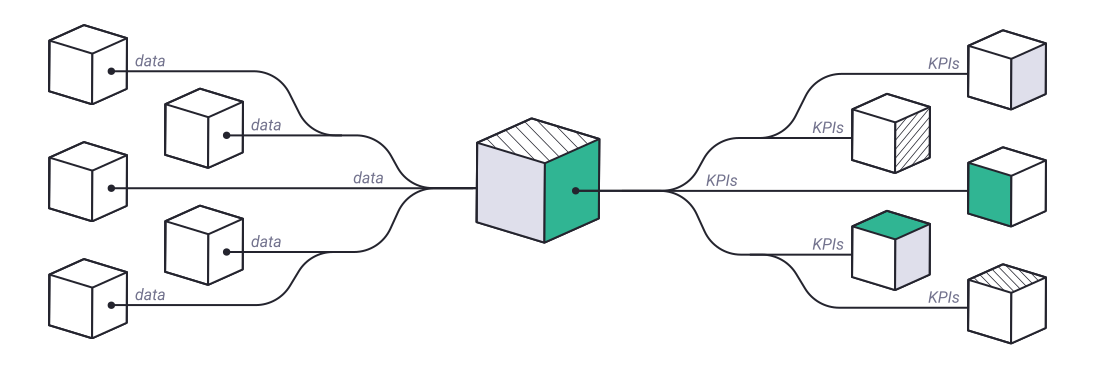
At Infinite Lambda, we start architecting new data platforms with a crystal clear purpose: capabilities must align directly with the organisation’s genuine business needs and existing operational processes.
This commitment goes far beyond basic data storage, as it requires engineering the platform to guarantee scalability, flexibility, and crucially, excellent usability for day-to-day tasks.
Each and every technical decision, from data warehousing structures to underlying data models, must be validated against whether it makes the end-user's job easier or quicker, weather that is generating a crucial quarterly report to optimising a supply chain route.
Purpose-driven architecture is the direct route to maximising return on investment (ROI), fostering team happiness, and achieving any relevant KPIs, attached to the project.
How to embed data into daily operations
True data adoption transcends passive checks on dashboards or receiving automated alerts. It demands completely reimagining the ways of working, mirroring the way many teams have programmatically embraced Generative AI because it instantly addresses real needs.
This is a utility-driven approach that is at the core of being genuinely data-driven.
For data leaders, this means prioritising the semantic layer, as it is the critical nexus where technology precisely aligns with business concepts and definitions. It is here that the business defines its metrics and terms, creating a single, trusted language.
And, of course, the semantic layer is essential for feeding contextualised, governed data to AI initiatives, making its implementation the ultimate focus for deep, workflow embedded adoption.
Successful adoption takes a data culture
Curiosity, collaboration, and trust around data are the true driving forces behind sustainable innovation.
Leaders cannot buy a data culture; they must deliberately cultivate it with the support of senior leadership. This involves incentivising the adoption of new platforms and integrating data usage into core business routines and performance reviews.
When people feel safe to explore data, ask difficult questions, and collaborate across departmental silos to solve problems, the platform moves beyond being a cost centre and becomes an engine for continuous, organisation-wide learning and improvement.
Planning for sustainable modern data platform adoption
Sustainable adoption comes from constant engagement; it is not a one-off launch event. This is why it is paramount to establish robust, closed-loop feedback mechanisms that encourage
- Listening to stakeholders;
- Iterating on platform features;
- Refining the user experience during and after deployment.
To ensure that the platform evolves in lockstep with business needs, data leaders need a formal strategy for continuous engagement, involving training and regular user groups.
This iterative approach maintains momentum and shows users that their daily struggles and the improvements they suggest are genuinely heard, and the transformation programme is designed to address them.
Data migration metrics that matter
In a data modernisation, measuring success should cover far more than basic technical metrics, such as system uptime or the number of tables migrated.
Truly meaningful metrics are fundamentally human. They are connected directly to user adoption, learning, and fulfilment.
Data leaders should prioritise tracking:
- Active user engagement;
- Reduction in time taken to achieve a useful insight
- Evidence of upskilling.
Teams that are happy with their tools and feel empowered to learn and grow deliver profound value, both tangible and intangible, to internal and external stakeholders alike.
If data leaders focus on empowering people and enabling their continuous development, they will set up their organisation for a much stronger, more competitive organisational positioning than if they simply switch to new technology.
End-to-end modernisation
What you want to avoid is implementing brilliant technology only for it to never get adopted by users because they do not trust the data.
As a data leader, you know that sudden migrations come with disruptive events, which erode stakeholders’ trust in data before you have even implemented the new platform. Hence, a migration approach that builds trust from day one is crucial for both early wins and long-term adoption.
Infinite Lambda’s end-to-end data modernisation solution, Flowline, automates the translation of legacy ETL code into dbt, providing an initial like-for-like shift, which is essential.
This is not a lift-and-shift migration, but a robust, highly automated process that gives stakeholders the confidence that their data is in good hands.
Starting with guaranteeing that existing outputs remain stable, we enable the client teams to get up to speed with the modern data stack as we build.
Once the system is migrated and trust is established, the client’s technical teams feel confident to commence optimisations. At the same time, we start meaningful interactions with non-technical users to identify their 80:20 pain points and focus on business value.
Having built trust in the new platform across teams and users, you can enable the entire organisation to embrace a new way of working.
Insights from successful data transformations
Common pitfalls to avoid
One of the most destructive pitfalls is the technology-first approach, where a brilliant platform is built based purely on the latest trend or vendor hype, often ignoring the organisation’s unique culture and stakeholder needs.
I saw this challenge with an insurance client that had embarked on a lengthy migration journey from legacy SQL Server / SSIS ETL system to dbt and Snowflake. The project had been off to a promising start, with a successful like-for-like migration. The internal technical team had done a wonderful job in terms of technology, but the setup would provide no visible value to non-tech stakeholders.
Instead of empowering users, the whole project was causing inertia across roles. The main data users, a team composed of SQL-proficient analysts with some Python skills, feared the move, believing they lacked the technical capability to own their data.
This was the point when Infinite Lambda entered the project. It was clear our priority would be to empower the team to create their own data product, and we quickly recognised Snowflake as the perfect solution.
Working with the client’s data architect, we brought client analysts up-to-speed with dbt and helped them build a small Data Vault.
This gave analysts a confidence boost, showing them they could maintain and evolve their own product. Stakeholders were impressed, as answers would come much faster, and we build a new, collaborative way of working with the architect.
Ultimately, this modernisation was a people project, whose success hinged on listening to the data users. Technology was simply the enabler of analysts’ newfound ownership and fulfilment.
Principles for successful modern data platform adoption
The primary principle for success in data migrations is aligning technology precisely with human processes to make adoption seamless and relevant.
Here is a great example from my practice:
One of Infinite Lambda’s clients had a team of analysts who relied on complex spreadsheets. This created a huge risk of undocumented knowledge and poor data governance.
The analysts were reluctant to explore other ways, as they feared they would lose control over years of acquired processes.
We could have easily migrated the logic right away. However, we decided to focus on the analysts’ pain points, analyse their needs, and justify the change.
We asked questions like "How much time does it take you to swap datasets?" or "How long does it take to modify this model and understand its ramifications across other spreadsheets?".
Instead of forcing the new platform on them, our goal was to demonstrate exactly how the modern data stack would improve speed and data reliability, making their lives easier.
Again, technology had to gain the analysts’ indispensable buy-in, before it could become the powerful enabler that would protect the organisation's vital knowledge.
Looking ahead
The transition to a modern data enterprise is a continuous journey of cultural and technological change.
Data leaders and Chief Data Officers (CDOs) must recognise that their most challenging yet critical task is to prioritise adoption, user experience, and human alignment early on in the programme.
By designing data platforms and modernisation programmes that respect the human element, acknowledging the pain of changing workflows and proactively addressing the fear of disruption, organisations ensure their massive data investments translate into genuine, sustained competitive advantage.
Infinite Lambda has helped over 100 companies modernise their data systems and create platforms that benefit the entire organisation, enabling AI use cases and being trusted by users.
If you would like to see how this works in practice, reach out.
Explore our case studies to learn more about how we have been enabling leading organisations.
About the author: Gianluca Ameruoso is a Chief Customer Success Officer at data and AI consultancy Infinite Lambda. A data leader with a passion for turning complexity, he aligns architecture, teams, and technology with business priorities to drive data strategies that create tangible impact. Connect with Gianluca on LinkedIn.