Skip to content





This article is going to show you how to make your cloud warehouse move cheaper and better with Data & AI: Fast and Slow (DAFS).
This content is also available in audio format.
Cloud technology has become synonymous with cost savings and efficiency. Everyone says it is, so if you believe, “The cloud is cheaper. Always.” you are not alone.
But here is the reality check: for many organisations, that promised budget relief can turn into a costly disappointment. After failing to see the cloud as a financial win, some CIOs and CDOs are even reversing course, returning to on-premises infrastructure.
After over 100 full data and AI transformations, at Infinite Lambda, we developed a framework that helps organisations leverage their data and AI infrastructure to improve decision-making and efficiency throughout, from the edges to the core. We call that framework Data & AI: Fast and Slow (DAFS), and we even wrote a book about it. You can download it for free.
In practice, many cloud migrations miss the mark. In this article, we will explore the reasons for the failure, showing you how to make your own cloud warehouse transition effective, impactful, and sustainable using the DAFS approach.
We will share insights on how to turn a cloud migration into a legacy-defining accomplishment for today’s CIOs and CDOs, focusing on cost efficiency, flexibility, and new capabilities that become a key part of the organisation’s core strategy.
Beyond the cost of cloud
The idea that cloud computing offers automatic cost savings has proven to be far from universal. Over the last few years, influential tech voices have begun questioning this narrative. Cloud repatriation stories, like GEICO’s recent shift back to on-premises infrastructure after a costly decade of cloud migration, highlight a concerning trend. Instead of cutting costs, the company faced escalating bills and lower availability, feeling, in their own words, "at the mercy of public cloud vendors."
This movement away from the cloud, championed by firms like Andreessen Horowitz and influential figures like David Heinemeier Hansson, is not just about costs. It is about control, risk, and rethinking assumptions.
In GEICO’s case, the error was not simply switching to the cloud; it was about choosing the wrong strategy for the move. By following a lift and shift approach, they merely transferred their existing infrastructure to the cloud without optimising it, gaining few benefits, if any at all, and facing many challenges they could never fully overcome.
The issue, fundamentally, is in the approach — moving to the cloud requires a new vision and strategic transformation. Instead of simply replicating what you had on-premises, cloud migration offers an opportunity to reshape, modernise, and enhance your data architecture.
Infinite Lambda’s Data & AI: Fast and Slow (DAFS) framework offers a robust plan to establishing a cloud warehouse platform, which caters to all types of data, while creating a thriving environment for AI.
The approach we suggest reimagines how your data platform works, optimising use across the fast-paced edge of your business and the slow-moving, deep insights that guide strategic direction.
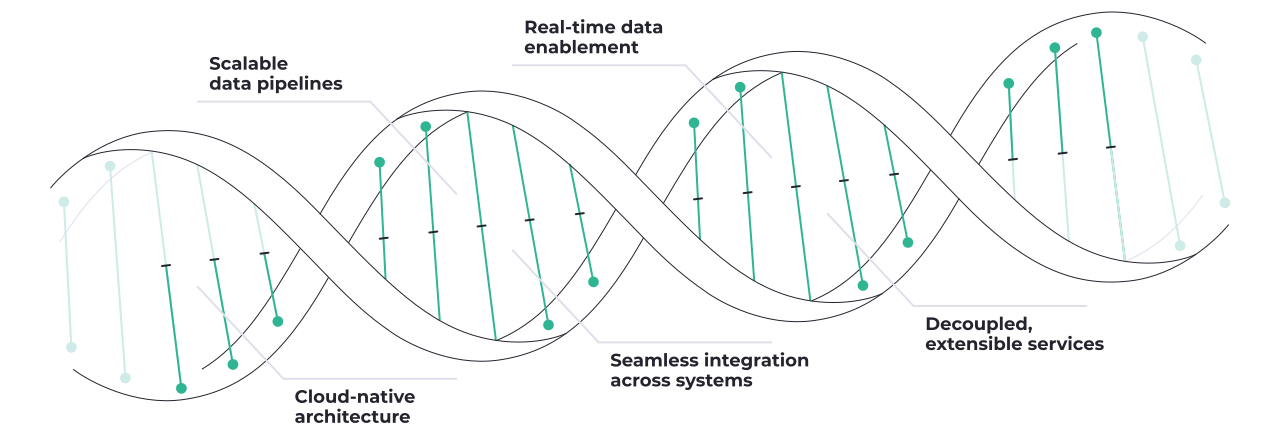
The pillars of a cost-efficient data platform
Let’s have a look at the essential pillars of a data platform, which is aligned with the principles of Data & AI: Fast and Slow, and see how each pillar contributes to a sustainable, cost-efficient cloud architecture.
Cloud-native architecture
A cloud-native architecture is purpose-built to leverage the elasticity, security, and scalability of cloud infrastructure, which are vital for handling the velocity and volume of modern data abundance.
Being on the cloud should not boil down to renting someone else’s servers. If you execute your migration right, you will be tapping into a platform that grows, shrinks, and adapts to your demands in real-time. Gone are the fixed costs and overheads of maintaining dedicated Storage Area Networks (SANs) or complex networking layers.
Leveraging the DAFS framework, you build a platform that offers:
- Elastic scaling to match resource needs in real-time, reducing costs during low usage;
- High availability with fewer points of failure, ensuring consistent access to data;
- End-to-end security tailored to meet modern compliance needs across multiple data types.
This way, organisations can achieve both operational efficiency and robust data management, aligning infrastructure performance with business demands seamlessly.
Scalable data pipelines
One of the biggest advantages of cloud-native tools is the capability for real-time data handling. Scalable pipelines ensure that your data flows seamlessly, whether in a constant stream or as micro-batch updates.
This enables:
- Flexibility in data handling so you can adjust pipelines to meet demand;
- Optimised performance without sacrificing cost, as pipelines adapt to load.
Real-time pipelines, combined with cloud-native resources, give your organisation the ability to act on data as it happens, delivering instant insights that on-premises solutions can struggle to match.
Seamless integration across systems
As your data moves to the cloud, it is essential to maintain connectivity with legacy systems.
DAFS encourages integration through standard APIs, meaning:
- Effortless connectivity across platforms, teams, and geographies;
- Access to historical data alongside real-time inputs, ensuring a comprehensive view.
By breaking down silos and maintaining easy access to legacy systems, your data architecture becomes more flexible, allowing your team to leverage data in a range of formats and contexts.
Real-time data enablement
The ultimate goal of DAFS is to enable informed decision-making across the business. With real-time data validation and governance, every department can access and act on the data they need.
- Enhanced data accessibility means insights are not just for analysts but for decision-makers at every level;
- Automated data governance allows data to flow freely but securely, maintaining quality and compliance.
This empowers your team to make fast, data-informed choices without compromising on accuracy, a crucial element in today’s competitive landscape.
Decoupled, extensible services
In traditional infrastructure, adding new capabilities often involves re-engineering the entire system. DAFS recommends a loosely coupled architecture where individual services can be independently updated, extended, or replaced.
This empowers you through:
- Adaptability to future needs, ensuring long-term viability of your platform;
- Modular design that enables faster development, easier troubleshooting, and more seamless upgrades.
With this approach, your cloud migration is not a one-time project but a foundation that grows and evolves alongside your organisation.
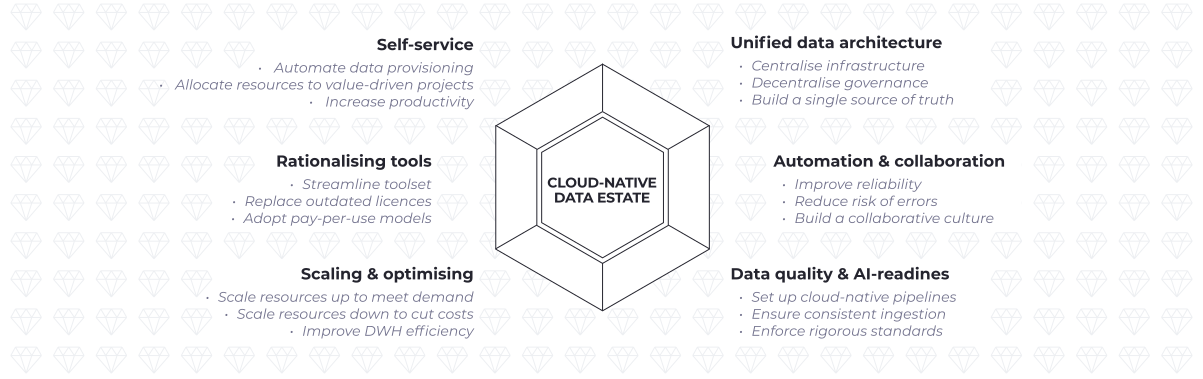
A vision for your cloud-native data estate
Your company has decided to migrate to the cloud — not just to modernise existing infrastructure, but to transform its operations and the way it leverages data.
A successful migration goes far beyond a technical shift. For the business, it can bring a competitive edge for the next decades. For you, it is the chance to showcase your strategic vision as the tech leader that transformed the company’s future.
In this new world, data is effortless — easy to access, simple to use, and inherently trustworthy.
More than 80% of all data requests are automatically serviced, freeing teams to focus on the innovation and the activities that create value.
Self-service tools empower every employee to make faster, smarter decisions. In each business unit, embedded data experts are harnessing cutting-edge AI to uncover new opportunities. Both creativity and efficiency thrive across the organisation.
The first step to all of this, and the one you have been contemplating for a long time now, is moving to a modern data platform on the cloud.
This modern platform means that internal and external data products are developed and deployed at lightning speed to create new revenue streams and enable rapid experimentation.
It is all tied together by a unified data architecture. A blend of centralised infrastructure with decentralised governance empowers each team to manage their data independently, while fostering a culture of trust and relentless innovation.
Migrating to the cloud is more than shifting data; it is the opportunity to modernise your entire data estate. As a tech leader, you only have one chance to get it right for your organisation.
Here is a strategic blueprint to ensure your cloud journey delivers the expected value from day one and reduces the Total Cost of Ownership (TCO).
Rationalising your tools
Use the cloud migration to streamline your toolset, replacing outdated licences with pay-per-use models and best-in-class platforms. This will quickly reduce direct costs. In the long run, it will also eliminate hidden inefficiencies that come from using fragmented, overlapping tools.
Automation and collaboration
A modern, cloud-native data estate enables data developers and business users alike to work more effectively. We often associate automation solely with speed. In fact, it is also key for reliability and accessibility, making processes less prone to error. When you templatise and automate a process, you remove redundancies, eliminate silos, and build a culture of collaboration.
Scaling and optimising
Take advantage of the cloud’s elasticity — scale resources up when demand is high, then scale down to save costs. Cloud-native data warehouses like Snowflake adjust automatically, ensuring you are always right-sized for performance and efficiency.
Data quality and AI-readiness
Advanced analytics and AI rely on a robust foundation of high-quality data. To pave the way for AI-driven insights, you need to set up cloud-native pipelines for consistent, reliable ingestion. Use tools like dbt and Fivetran to establish rigorous standards for data transformation and ensure your data is AI-ready from the very start.
Self-service
Developers, analysts, and other users in your organisation need direct access to relevant data. The most reliable and efficient way to do that is through automated provisioning of data resources and infrastructure.
This self-service approach allows you to allocate more resources to value-driven projects, increasing productivity and speeds up innovation.
Unified data architecture
The Unified Data Architecture approach combines the best of centralised infrastructure with decentralised governance. Essentially, it gives you the balance to foster efficiency, improve flexibility and maintain control.
This architecture type provides the foundation for a single source of truth, as it helps establish a centralised infrastructure that automates data management and integrates seamlessly with various tools and systems.
At the same time, governance is decentralised, following federated data governance principles. This way, you empower individual teams to manage their data domains independently, and foster accountability and ownership across the organisation.
Leveraging cloud-native tools for cost efficiency
Snowflake, Fivetran, and dbt are examples of cloud-native tools that not only offer best-in-class capabilities but also integrate seamlessly with other cloud services. This interoperability allows for advanced automation and template-driven deployments that align with your organisational needs.
Standardising best practices across provisioning, permissions, and policies means you can create a unified, high-performing data ecosystem that supports both growth and cost control.
Steer clear of the lift and shift mindset
The key to a successful cloud migration lies in moving away from the lift-and-shift mindset. Instead, aim to create a new vision for your data architecture, one that harnesses the unique advantages of the cloud and aligns with your strategic goals.
At Infinite Lambda, we have packaged these principles with software automation into a cloud warehouse modernisation offering, which is designed to deliver a DAFS-compliant data estate with unparalleled efficiency and quality.
Our approach combines automation, replatforming, and refactoring, providing a fast, reliable transition to a cloud-native architecture that delivers value both today and long into the future.
The cloud’s full potential
Cloud-native should not be a buzzword but a transformative way to rethink how you architect your applications, and how your data serves internal and external customers. Rather than feeling “at the mercy of cloud vendors,” you have a chance to build a platform that supports innovation and growth, turning your data estate into a competitive advantage.
The cloud holds immense potential, but unlocking that potential requires more than just moving servers from one location to another. With DAFS, your cloud journey becomes a structured, strategic transformation that enhances capabilities, reduces TCO, and positions your organisation for future success.
Launching a cloud migration is a massive commitment. Having the experience of over 100 successful transformations, we designed an accelerated, intelligent approach to migrating from an on-premises warehouse to a modern, native data cloud that turns the vision we outlined earlier into a reality.
This is not a simple lift-and-shift. Instead, it is a combination of extensive experience, a robust proprietary framework and a suite of tools that all come together to accelerate your project, enhance your data estate and fundamentally transform the way your organisation leverages data.
If you are ready for the next step, take advantage of a free assessment and feasibility check.
To learn everything about our holistic framework, get a free copy of our book Data & AI: Fast and Slow.
This article is also available in audio format.
Disclaimer: This content was created by real people, the Infinite Lambda experts. AI only enabled us to offer the audio version, which you may find more convenient.